The Ideal of Being a Man of the Mountains
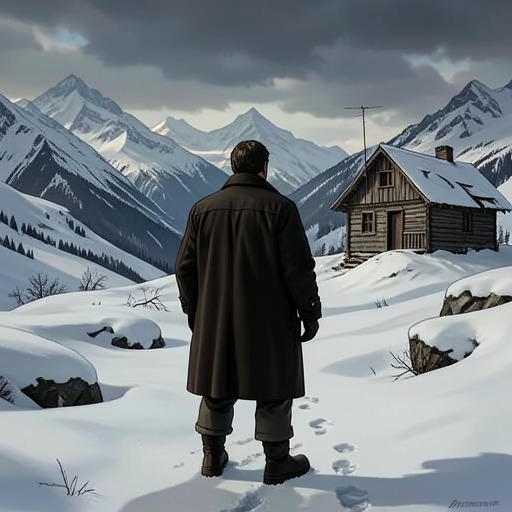
The Eight Mountains: A NovelThe Ideal of Being a Man of the Mountains is Bruno’s name for a life shaped by the mountains rather than by the valley’s measures of work, money, and social success. It is not simply a romantic attachment to high places: it joins inherited knowledge, practical competence, a sense of kinship with a neglected landscape, and a decision about what Bruno can do well. Its force comes from the tension between self-recognition and self-limitation. The mountains give Bruno a life he can claim as his own, yet his withdrawal into them also threatens to reproduce the silences and absences that have marked his family.
An Identity Learned in the Landscape
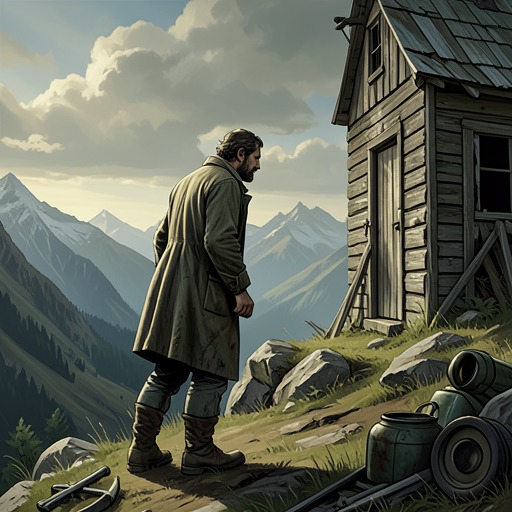
Bruno’s understanding of himself is grounded in a lifetime spent reading the mountain terrain. As a boy, he leads Pietro away from established paths and interprets traces that Pietro cannot recognize: a rusted cable-lift mechanism, ground blackened by an old charcoal works, and the excavations and ruins scattered through the woods. These remains are not empty scenery to Bruno. He reads them as evidence of lives and work that have mostly disappeared, translating the landscape for his friend as if its signs were words in a dead language.
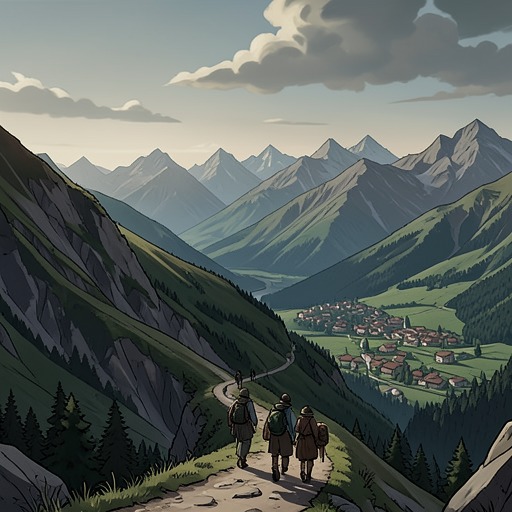
That practical knowledge is inseparable from a vocabulary of belonging. Bruno teaches Pietro the local names for trees, rocks, rivers, and the sheltered overhang called a barma. He also explains how a valley has two contrasting sides: the sunny adret, with villages and fields, and the shadowed envers, left to woodland and wildlife. The boys prefer the reverse side, where they can explore without being disturbed. The ideal that Bruno later names therefore has an early, concrete form: knowing how to move through the mountains, recognize their features, and find a place within them.
The landscape also contains evidence of abandonment. Bruno knows derelict houses, wild meadows, and old workings, and he distinguishes himself from relatives who have given up on the family farmstead. His account of the place’s decline is specific: a broken chair would be burned rather than repaired, and invasive plants in the meadow would be left alone. His father resents even hearing the farmstead mentioned and takes a kind of satisfaction in imagining its ruin. Against this refusal to care for the land, Bruno’s later ambition to live in the mountains represents a different response to the same inheritance.
Inheritance, Education, and Kinship
Bruno’s commitment is not presented as a simple inheritance from the men of his family. He says that, for a time, leaving the mountain life had seemed inevitable: the valley was where money and work could be found, while the higher ground appeared to offer only weeds and ruins. He eventually recognizes that he is unlike his father, uncle, and cousins, and identifies his mother as the person he resembles. Pietro reaches the same recognition in the moment, seeing that Bruno’s call toward the mountains comes through her rather than through the men who had treated the farmstead as a burden or a lost cause.
Bruno’s mother’s circumstances sharpen the meaning of that resemblance. Bruno observes that a man can choose to live quietly in the woods without attracting the same judgment as a woman who does so; a silent woman may be regarded as half-crazy. He believes his mother would have been able to live the life she wanted if she had been a man, and describes her marriage as an ill fit from which she was fortunate to escape. His ideal thus carries a gendered recognition: he can inhabit a form of solitude that, in his view, would have been denied or condemned in her.
His early relationship with Pietro’s family supplies another contrast. Pietro’s mother works persistently with Bruno’s aunt to secure his winter schooling and summer homework visits. In the kitchen, Bruno reads novels and struggles with Italian grammar, which feels to him like a foreign language. He does not complain, despite the difficulty, because he understands that his education matters to Pietro’s mother. On occasional family walks, he adapts to the family’s routines and responds to Pietro’s father with a respect close to adulation. These experiences show that Bruno is not incapable of attachment or learning beyond the mountains. They also make clear that his later declaration of identity is a choice made after encountering other possibilities, not an identity that was obvious from the start.
Work Beyond the Mountains and the Return to a Calling
Bruno’s adult experience tests whether his ideal can survive contact with other kinds of work. He takes part in establishing a mountain farm and cheese business, and for a time the first cheese shipment gives the enterprise a tangible result: a mule carries twelve loaves, weighing sixty kilograms in total, down toward the valley. Bruno kisses Lara, pats the mule, and sends Pietro and Lara off with the load while he returns to clean the stable. He has decided that transport is not work for him: the mountain man stays in the mountains, while his partner goes up and down with the goods. The division makes his preferred identity visible in an ordinary task, while also assigning the outward-facing labor to Lara.
Later, after the farming venture has failed, Bruno recognizes that becoming a businessman required abilities he did not have. He regrets not having started with a small place and four cows, and concludes that he knows how to live in the mountains, even alone. The recognition is not presented as effortless triumph: it takes him until he is forty to understand the value of what he can do. He reframes failure not as proof that the mountain life is worthless, but as evidence that he had tried to measure himself by a form of work unsuited to him. The ideal consequently changes from an inherited possibility he once might have abandoned into a deliberate account of his capacities and limits.
Solitude, Continuity, and the Cost of Staying
The life Bruno chooses has a stark appeal. In the small house that Bruno and Pietro built together, he describes being able to cope alone through the winter with little food and his own thoughts. Pietro is drawn to the integrity of this vision, even as he recognizes that such a life would seem inhuman to anyone else. The ideal promises independence from the demands of business and from the valley’s ordinary measures of success, but it does not resolve the question of what solitude costs other people.
That cost becomes explicit when Pietro urges Bruno to go down and change his way of life. Bruno answers by insisting on who he is: a cowherd, a bricklayer, and a man of the mountains. Pietro remembers another identity in the same breath: Bruno is also his father’s son. Like his father, he may disappear from his child’s life. The mountain ideal, in this exchange, is both a hard-won recognition of Bruno’s abilities and a defense of a way of life that can become abandonment. His certainty does not make the consequences disappear.
The house built by Bruno and Pietro offers a counter-image to that isolation. When Pietro’s mother visits, she sees the completed house, its open wooden room, and the inscription honoring Giovanni Guasti. Pietro tells Bruno that the house should belong to both of them, not to Pietro alone, because they built it together. The shared house does not erase their different choices or guarantee that Bruno will leave the mountains. It does, however, turn mountain living into a relationship and a lasting joint undertaking, rather than merely a solitary claim. The ideal’s deepest significance lies in this unresolved balance: Bruno can remain faithful to what he knows how to do, but the story asks whether staying put can coexist with responsibility to those who may otherwise be left behind.